Subaru Outback Wilderness: Is It Built for the Way WA Explores?
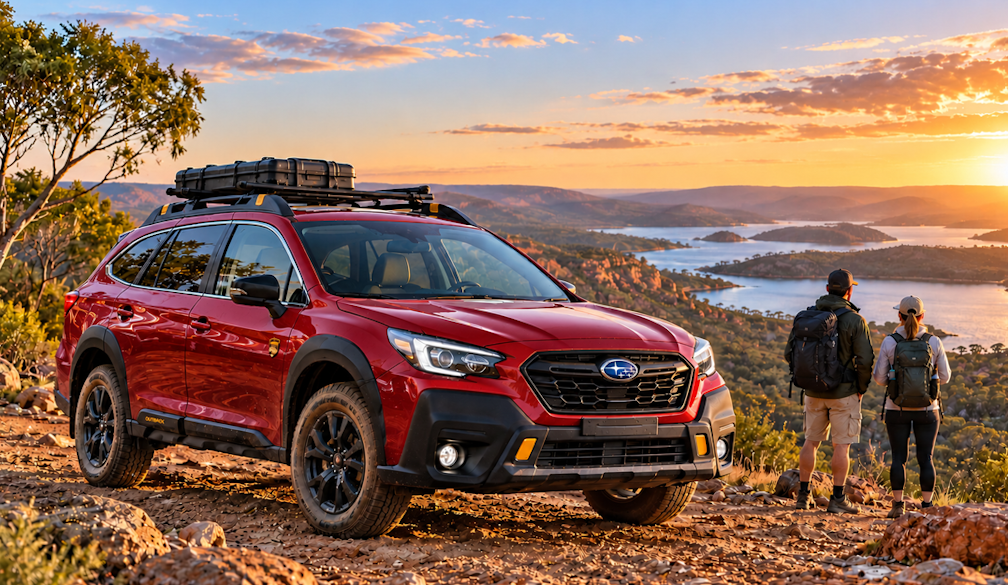
For years, Australians watched overseas buyers drive away in Wilderness-badged Subarus while we went without. That has changed. The Subaru Outback Wilderness is the first Wilderness model sold in Australia, and searches for it have climbed quickly since launch.
The interest makes sense in WA. Plenty of us want something that handles the Mitchell Freeway on Monday and a gravel road to a campsite on Saturday, without the size and running costs of a large four-wheel drive. The Wilderness promises to sit right in that gap.
So what is it really, how does it differ from the Apex, and where can you realistically take it?
What makes the Wilderness different from a regular Outback?
It isn't just a sticker pack. The Subaru Outback Wilderness changes the hardware that matters off the bitumen.
- Turbo power: a 2.4-litre turbocharged boxer making 194kW and 382Nm. In the new range, it's the only Outback with a turbo.
- More clearance: 240mm, compared with 220mm on the standard Outback.
- Adaptive suspension: electronically controlled dampers with Wilderness-specific tuning, plus improved approach and departure angles.
- Dual-mode X-Mode: two settings that adjust throttle, transmission and traction control for different loose surfaces.
- A full-size spare wheel: a genuine asset when the nearest tyre shop is hours away.
- Practical touches: water-repellent synthetic leather seats, stronger roof rails, reinforced tie-down points and MOLLE anchor points in the cargo area.
- Towing: up to 2,100kg braked.
Wilderness or Wilderness Apex: what's the difference?
Mechanically, nothing. Both grades share the engine, suspension, clearance and towing capacity.
The Wilderness Apex adds comfort and convenience:
- 12-speaker premium sound system
- Panoramic 360-degree view monitor
- Electric sunroof
- Satellite navigation
Of those, the 360-degree camera is the one with real off-road value. On a narrow bush track, it helps you place the wheels around rocks and ruts and spot obstacles below the bonnet line. Built-in navigation is also handy in regional WA, where phone reception drops out quickly.
If you'll mostly drive in town with occasional gravel trips, the standard Wilderness gives you all the capability for less outlay.
Where can you take it in WA?
Be honest about the Wilderness. It is a highly capable all-wheel drive, but it doesn't have low-range gearing like a dual-range 4WD. Within that limit, WA offers plenty.
Well suited:
- Gravel forestry roads around Dwellingup and through the Darling Range
- Unsealed roads into national park campsites in the South West
- Long highway runs to Kalbarri, Exmouth or Esperance with a loaded roof and a trailer
Possible with preparation:
- Beach driving at spots such as Lancelin. Australian-spec Wilderness models come on road-biased tyres, so lower your tyre pressures, carry a gauge, a compressor and recovery gear, and travel with another vehicle. Check local access rules and permits first.
Best left to dual-range 4WDs:
- Remote, technical routes such as the Holland Track
- Deep water crossings and steep rocky climbs
Plan within those limits and the Wilderness will take you a long way past where most SUVs stop.
Who is the Outback Wilderness really for?
The Wilderness makes the most sense for people whose weekends regularly leave the bitumen but whose weekdays don't.
- The weekend camper who wants to reach a bush campsite without towing a second car's worth of gear.
- The coastal surfer or angler heading north of Perth on sandy access tracks, who needs clearance and a full-size spare more than a lifted ute.
- The family with a boat or camper trailer that sits within the 2,100kg braked rating.
If your plans involve long remote expeditions, a dual-range 4WD is still the better tool. If they involve getting further than a standard SUV allows, without giving up a comfortable daily drive, the Wilderness is a very good fit.
What should you know before buying one?
A few practical points help set expectations.
- Fuel: the turbo uses more than the 2.5-litre engine, and independent testing found it slightly thirstier than the previous Outback turbo. It runs on regular 91 RON unleaded.
- Transmission: the Wilderness is automatic only, using a Lineartronic CVT with a manual mode.
- Tyres: if beach trips are a regular plan, ask about all-terrain options and budget for them early.
- Test drive on gravel: a lap of the block won't show you what the dampers do. Ask for a longer drive that includes rough or unsealed road.
It's also worth comparing both grades in the same visit at a dealer such as Perth City Subaru, and seeing which colours are available, as the Wilderness palette includes earthy greens and blues inspired by the outdoors. Browsing current Subaru Outback Wilderness for sale in Perth before you book a drive makes that comparison quicker.
Subaru Outback Wilderness: quick answers
Is the Outback Wilderness a 4WD? It's all-wheel drive with X-Mode, not a dual-range 4WD with low-range gearing.
What's the Outback Wilderness ground clearance? 240mm.
How much can the Outback Wilderness tow? Up to 2,100kg braked.
What fuel does it use? Regular 91 RON unleaded.
The bottom line
The Subaru Outback Wilderness is the most capable Outback yet, and it finally gives Australians a factory-built adventure version of a car many already trust. Turbo power, 240mm of clearance, adaptive dampers and a full-size spare make it a strong match for how WA people actually explore: long distances, gravel roads and the occasional sandy track.
Choose the standard Wilderness if capability is the priority, or the Apex if you want the 360-degree camera and extra comfort on long trips. Above all, match the car to the places you'll really go. Do that, and the Wilderness will open up a lot more of this state.